
Are You Paying?
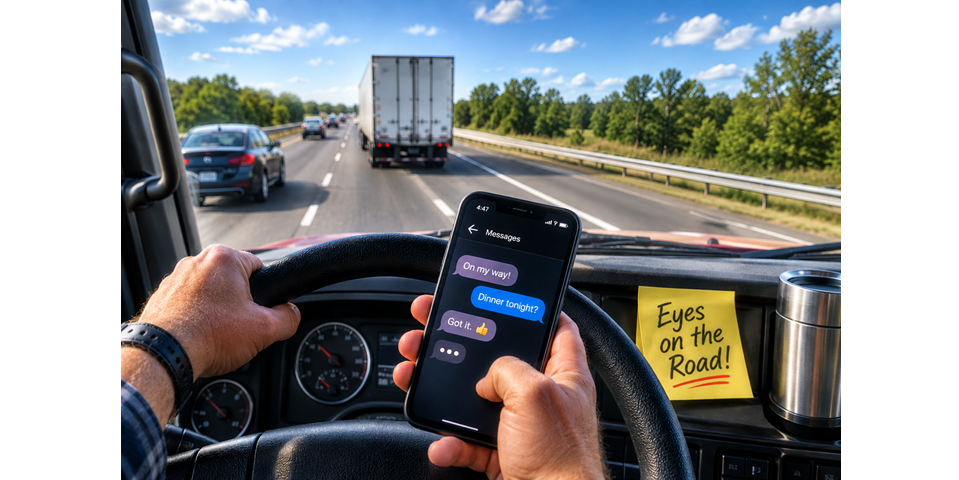
Trucking today is nothing like it was when I started more than three decades ago. Highways have changed. Trucks have improved. Drivers have evolved. Traffic has worsened. Regulations have grown. None of these are inherently better or worse, except for the traffic, but all are different. The biggest change over the years is the presence of distracted drivers, both truck drivers and car drivers.
It used to be that if you saw another vehicle, car or truck, driving erratically, you would assume they were intoxicated or, at the very least, maybe having a medical event. Today, it is usually from some distraction in the vehicle like a cell phone, tablet, GPS or some other electronic device that has taken the driver's attention away from the task of actually driving the vehicle.
I would say that on a daily basis, I have to move to one side of my lane of travel to avoid a sideswipe from another vehicle. This is no longer an isolated incident, but a daily occurrence, multiple times per day. It is not just the cars either. Trucks weaving from side to side, crossing the lines of their lane and narrowly missing the side of my truck, if I hadn't been watching them approach in the mirrors.
Anyone can get distracted with all the technology we drive around with today. The problem is that too many drivers focus on the devices instead of their driving and their surroundings.
The same technology that makes cars and trucks safer and easier to drive has left some drivers believing the vehicle will handle the driving while they watch Netflix on a tablet or type out messages on their smartphone. Even talking on the phone is a distraction. Bluetooth helps free up your hands, but if you are too focused on the conversation, you are still a distracted danger on the road.
GPS has reduced or eliminated the need for a road atlas for many drivers, but ultimately, the driver still needs to use the windshield for the best guidance.
Technology itself isn't the problem. Many of the advancements we've seen over the years have made driving safer and more convenient. Modern trucks have better braking systems, stability controls, collision avoidance systems and lane departure warnings. GPS helps us find our destinations, and electronic communication makes it easier to stay in touch with dispatchers and customers. These are all useful tools.
But there is a difference between using technology to assist you and relying on it to do your thinking for you.
A GPS can tell you to turn left in 500 feet, but it can't always tell you that the left lane is blocked by construction, that traffic ahead is coming to a sudden stop, or that the vehicle in front of you is about to make an unexpected move. It can give you directions, but it can't replace your judgment. I've seen drivers follow their GPS instructions right into places where a truck has no business being. At some point, you have to look up, evaluate your surroundings and decide whether what the device is telling you actually makes sense.
The same applies to all those safety features built into modern vehicles. Lane departure warnings and collision avoidance systems can be lifesavers. But they are there to help the driver, not relieve the driver of responsibility. Just because your truck can warn you that you're getting too close to another vehicle doesn't mean you should be waiting for that warning before paying attention.
There is also a difference between looking and seeing. You can glance at the road and still not really see what's happening around you. You can look in your mirrors without recognizing that the truck approaching from behind is drifting into your lane. Driving requires more than having your eyes pointed in the general direction of the road. It requires paying attention to what you're seeing and anticipating what might happen next.
Professional drivers should understand this better than anyone. We spend our days watching traffic, checking mirrors, judging distances and anticipating the actions of other drivers. We know that a passenger vehicle can disappear into a truck's blind spot, that stopping distances are considerably longer in a loaded truck, and that a moment of inattention can have serious consequences.
Yet professional drivers are just as guilty of distraction as anyone else. We have dispatch messages, load information, electronic logs, navigation systems and phones competing for our attention. Sometimes there is a legitimate reason to interact with one of those devices, but that doesn't mean it needs to happen while the truck is moving. There is a time and place for checking a message or making a phone call. The middle of a busy highway isn't it.
And let's be honest. We have all probably been guilty of allowing something to take our attention away from driving at one time or another. Nobody is perfect. But recognizing that doesn't make it acceptable, and it certainly doesn't make it any less dangerous.
I don't expect us to go backward. I'm not suggesting we get rid of our GPS units, throw away our smartphones or return to the days of paper maps and handwritten directions. Technology has made many aspects of trucking better. I wouldn't want to give up the improvements we've gained over the years.
What I would like to see is a little more attention paid to the job of driving. Not just by professional drivers, but by everyone who gets behind the wheel. Put the phone down. Stop trying to read a message while moving down the highway. If you need to adjust something, find a safe place to stop. And if a conversation is distracting you from what's happening around you, end the conversation.
We have better trucks, better roads in many places, better navigation and more safety equipment than ever before. We have more information available to us than any generation of drivers before us. But none of that changes the basic responsibility that comes with operating a vehicle.
The next time you're driving down the highway, remember that the other vehicles around you are not just obstacles to navigate around. They are being operated by people who are counting on you to pay attention. And you are counting on them to do the same.
Technology can help you get where you're going, but it can't take responsibility for getting you there.
In Europe, the windshield is often referred to as a windscreen. Perhaps if we adopted that term, it might remind us which screen in the vehicle deserves the most attention. The windshield is still the most important screen in your vehicle.
Are you paying attention?
The simple act of paying attention can take you a long way.
- Keanu Reeves
See you down the road,
Greg