
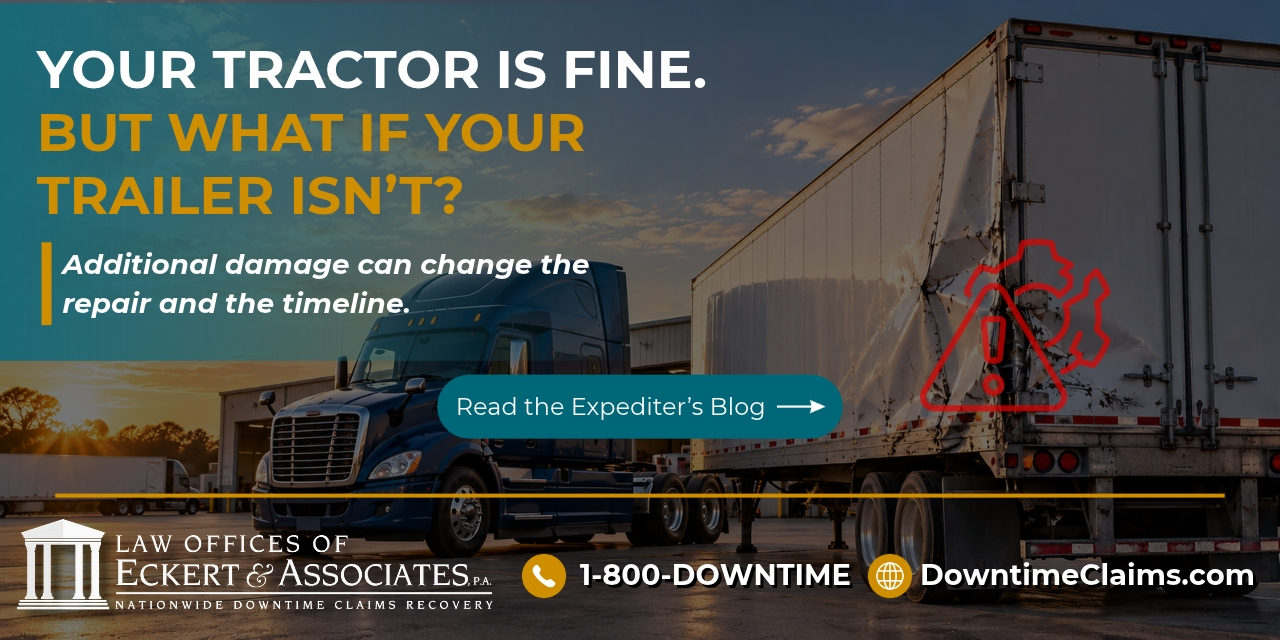
Your Tractor Is Fine. But What If Your Trailer Isn't?
When people think about a commercial truck accident, they often picture damage to the tractor.
A crushed bumper. A damaged hood. A truck sitting in a repair shop waiting for parts.
But what happens when the tractor is still operational, and the trailer is the equipment that can't return to work?
For owner-operators and motor carriers, a damaged trailer can create a different set of challenges. The truck may be mechanically capable of moving, but that doesn't necessarily mean the business can continue operating as usual.
And when an accident involves equipment that generates revenue, understanding the operational impact matters.
A Working Tractor Doesn't Always Mean a Working Business
In commercial trucking, the tractor and trailer serve different purposes, but both may be necessary to complete a job.
Depending on the type of operation, a driver may need a refrigerated trailer, flatbed, dry van, tanker, or other specialized equipment to transport a particular load.
If that trailer is damaged in a not-at-fault accident, the tractor might still be usable while the carrier faces limitations on the work it can perform.
For example, a carrier operating a specialized trailer may not be able to accept certain loads without the appropriate replacement equipment.
The important question isn't simply whether the tractor can move.
It's whether the equipment needed for the operation remains available.
Not All Trailers Are Easily Replaceable
Some trucking operations have access to multiple trailers. Others depend on one trailer to handle a specific type of freight.
Finding replacement equipment may be relatively straightforward in some situations. In others, availability, location, specifications, and cost can make the process more complicated.
A refrigerated trailer cannot always be replaced with a standard dry van. A flatbed may not be suitable for freight requiring enclosed transportation.
Even trailers within the same category can have different capacities, dimensions, or features.
That's why the type of equipment involved in an accident can affect how quickly normal operations resume.
What Happens to the Loads?
When a trailer is damaged, the next concern is often the freight.
Was the trailer loaded when the accident occurred? Could the shipment be transferred safely? Was another trailer available? Did the carrier have to arrange alternative transportation?
These questions matter because the consequences of trailer damage may extend beyond the cost of repairing the equipment.
A carrier may need to coordinate cargo transfers, notify customers, rearrange deliveries, or make other operational decisions.
Depending on the circumstances, those arrangements can involve additional expenses and disruptions.
Keep records of what happened to the shipment, what arrangements were made, and why those steps were necessary.
Consider Whether Replacement Equipment Is Available
One of the first practical questions after trailer damage is whether the business can continue operating with alternative equipment.
If another suitable trailer is available, using it may help reduce interruption.
If renting or leasing a replacement is an option, the carrier may need to consider availability, transportation costs, rental terms, and whether the equipment meets the requirements of its freight.
However, replacement equipment isn't always immediately available or economically practical.
The key is to evaluate reasonable options based on the actual circumstances rather than assuming every operation can easily substitute one trailer for another.
Document the options considered, the availability of suitable equipment, and the reasons behind the decisions made.
Keep the Tractor and Trailer Records Separate
When an accident involves multiple pieces of equipment, keeping organized records becomes especially important.
The tractor and trailer may have different owners, insurance arrangements, repair facilities, and operational roles.
A useful trailer-related file should include identification and ownership information, photos of the damage, towing and storage documents, inspection reports, repair estimates, and communications with the repair facility. It should also contain replacement trailer inquiries, rental agreements, freight transfer details, delivery records, and documentation showing how the accident affected business operations.
Keeping these records together can help establish what happened to the trailer and how the incident affected the business.
Keeping these documents organized can help establish what happened to the trailer and how the incident affected the business.
Does Trailer Downtime Qualify for a Loss-of-Use Claim?
Depending on the circumstances and applicable law, damage to a commercial trailer may support a loss-of-use claim.
However, the fact that a trailer was damaged does not automatically establish a recoverable downtime loss.
Important considerations may include the trailer's role in the business, the availability of suitable replacement equipment, the reasonable period of lost use, and the financial impact of the interruption.
For some carriers, trailer damage may significantly restrict operations. For others, alternative equipment may allow businesses to continue with limited disruption.
Each situation requires an evaluation of the facts and supporting records.
The Bigger Picture: It's About Operational Capability
A commercial vehicle accident doesn't have to leave the tractor completely disabled to affect a trucking business.
Sometimes the most significant interruption involves the equipment attached behind it.
A damaged trailer can change which loads a carrier can accept, how shipments are handled, and what arrangements are necessary to continue operating.
That makes it important to document not only physical damage but also the actual effect on the business.
The Bottom Line
When a commercial truck accident damages a trailer, don't focus only on whether the tractor is still running.
Consider the equipment your operation requires, the availability of suitable replacements, the freight affected, and the reasonable steps taken to keep business moving.
Preserve repair records, document the operational disruption, and track any necessary arrangements made while the trailer is unavailable.
Because in commercial trucking, a tractor that's ready to drive doesn't always mean the business is ready to deliver.
The information provided is for general informational purposes only and does not constitute legal advice. The availability and value of any loss-of-use claim depend on the facts and applicable law.